Things Are Just Not What They Appear To Be
I just finished reading Dinesh D’Souza’s latest book Life after Death, an excellent book. D’Souza is an evangelical Christian intellectual who defends the Christian faith against many of the top modern atheists. There was one part I found particular fascinating, which explains a lot about human relationships, our understanding of science, the news media, the Christian faith, and the Catholic faith. It is the relationship between objective truth and our subjective experience of the truth.
D’Souza wrote about two famous philosophers – Immanual Kant and Arnold Schopenhauer. Kant was a Christian and Schopenhauer was an atheist, but when Kant came up with this, Schopenhauer said Kant as the greatest genius ever. What Kant said is that there are two different worlds, the “noumenal world” and the “phenomenal world”. The noumenal world is the way things really are. The phenomenal world is the world we experience. Please bear through this. This is heavy philosophy, but understanding this may help others things in your life; it may save your marriage!
Kant is saying that the way we experience the world and the way the world actually is are two different things. For instance, consider a red apple. We may experience it as a red apple. But is it actually a red apple? Keep in mind that the redness of a red apple is only the light, with all the of its “color” rays hitting the apple, with most being absorbed by the apple. But some rays bounce off the apple and enter the pupils of our eyes. That sends impulses from our eyes into our brains, and the brain translates this into red. So is the apple actually red, or do we just perceive it to be red?
Let’s take this a step further. Suppose a color-blind person sees this apple. Suppose what most of us see as red, he sees as blue. So his experience of the apple is that it is a blue apple.
Let’s take this another step further. We have fours senses – we see, we taste, we hear, and we touch. We can use all our senses on the apple. We see the red apple. We can touch it, we can drop it and hear its thud, and we can taste it. Let’s say that an alien from outer space comes to visit. Let’s say that he has two more senses that we do not have. So his experience of the apple would be better than ours. He would be able to capture the real essence of the apple better than we can. So his experience of the apple would be closer to the essence of the apple than our experience of the apple.
Please do not misunderstand Kant. He was not a strict relativist. He believed that objective reality existed. He believed that the apple exists. But what he was saying was that this objective reality has to be filtered by our subjective senses. What really is and what we perceive it to be are two different things. What Kant said has far-reaching implications.
Marriage
My bachelor’s degree was in Family Services, which is basically about counseling – including marital counseling. One of the biggest sources of marital problems is the confusion of the noumenal world and the phenomenal world – what really is and what we perceive it to be. Much of family therapy is about overcoming this problem.
The husband comes home from work and says “Honey, I am going out bowling with my friends”. The wife retorts “Why don’t you just go live with them! I am sick of this!” The husband perceives that his wife does not want him to have any fun, and he responds “Look! I worked hard all day! And if I want to be with my friends and bowl, that is what I am going to do!” And he leaves, slamming the door. The problem is that the husband perceives that his wife does not want him to have any fun. But that is not what it is actually about. She just wants him to spend more time with her. If the husband understood this, he could then deal with that issue.
One thing that I learned in marital counseling is feedback is a very important way of arguing. The wife first said “Why don’t you just go live with them! I am sick of this!”, it would have been better for the husband to say “Honey, this is what I am hearing from you. I hear that you are saying that …”. Then the wife can provide feedback, to clarify what she is really upset about. So by repeating what is said to the other, this increases that chance of resolving the conflict.
But the key is realizing that your perception of reality may be different than reality. Psychotherapies
Now we can go overboard on communication and feedback. As a Christian, I believe that we are in a fallen world, and there is real evil out there. Sometimes a person does what he does, not because he is misunderstood, but that he is just plain evil. We cannot expect to sit with terrorists and think that we can resolve our conflicts by saying “Well, by you blowing up the tower, I hear that you are trying to say this…” This would be absurd. Evil must defeated, not understood. Many modern psychologists and psychiatrists try to explain away evil, which takes away the person’s responsibility for doing evil. Some psychiatrists have themselves realized that this is happening. Dr. Karl Menninger, who wrote a book called Whatever Became Of Sin?, has decried that the current state in counseling is that it has taken away man’s responsibility. If a man’s problems can be blamed on poor parental upbringing, then it takes away his responsibility for how he turned out. And if he is not responsible for what he became, then he does not have the power to change.
I studied different therapies in college, each with radically different psychological theories. Carl Rogers taught that man was basically good. Freud taught that man was basically a beast, doing the most altruistic actions for very base, often sexual motives. B. F. Skinner saw man as basically a robot, totally a product of his environment. Albert Ellis saw man as a brainiac, that he could be reasoned into mental health. Perls saw man as being all emotions, who could yell himself into mental health. The amazing thing is that although these therapists contradicted each other, they each have the same success rate! Not only that, but I remember in college class hearing that the same success rate is found to those who do not even bother going to any of these therapies! How is this possible?
Again, Kant can address the problem in therapy today. Counselors need be aware that reality and their perception of reality are two different things. Rogers, Freud, Skinner, etc. each have a different perception of reality. But you do not get that impression when you read them! Rogers believes that what he says is absolute reality. Freud is dogmatic that he is right and everyone else is wrong. So does Skinner. But it reminds me of the story of blind men experiencing an elephant. One touches that the ears are flat and says that the elephant is flat. The next touches the nose and says the elephant is round and long. The next touches the body and says it is huge. Each has a certain perception of the elephant. Each grab some parts of the truth, but not the full truth. Reality is more than just our small perception of reality. Each therapist needs to have some humility. He does not have all the answers.
We are besieged by reductionism, which in psychology is reducing man to being a beast with sexual drives, or a mere product of his environment. It is one blind man reducing the elephant to flat ears, and another reducing it to a round narrow nose. Each only experiences the phenomenal world and not the noumenal world. The elephant is more that just the ears and more than just the nose. A man is more than a mere beast, or the mere product of the environment. The real man (meaning male and female) is far beyond our nice little categories. There is a mystery to man, which prevents any therapist to capture him in a system of thought. If anything comes close to this mystery it is what the Bible says of man; he is made in the image of God.
But modern psychology is obsessed with reducing man into a mere machine, such as a psychologist who excuses evil on nothing more than bad parental upbringing. It is true that parental upbringing has a big influence on us, but there is still a free will. The psychologist may give you reasons, but we cannot be reduced to being a mere product of our environment.
A psychologist who says this is telling us more about himself than on reality. It is his own perception of reality that free will does not exist. But free will does exist. This is not a matter of perception, but logic. If free will does not exist, then what is the purpose of doing this website, or any website? And what is the purpose of you reading it? Reading and analyzing things are pointless if we have no free will to freely read and analyze. If we believed there is no free will, our actions would constantly contradict this. It is illogical to say there is no free will and then live as if there is free will. And since it is irrefutable that we have a free will, we are ultimately responsible for our actions.
Human Suffering versus Animal Suffering Our society has warped values. We hate Michael Vick for torturing and killing dogs, and yet we accept the slow dehydration of Terry Schiavo to death. PETA (People for the Ethical Treatment of Animals) want us to radically change our lives to prevent the torture and death of animals, but is silent about the millions of unborn children murdered every year. Some animal activists would throw blood on a woman wearing a fur coat, but then argue that woman has a right to have an abortion if she wants to. So a woman has the right to do her own body to do what she wants to when it comes her killing a developing human life inside her, but she cannot use her body to wear a fur coat! But how do we know that an animal suffers and experiences death the same way a human death? Atheist Thomas Nagel one wrote an article call “What It Is Like Being A Bat”. He points out that a blind bat “sees” things by echolocation. It transmits a sound and that bounces off of things, and by this his super-sensitive picks up where things are. Nagel explains that there is no way that we can know what this is like, because we do not share this experience with a bat. In the same way I cannot know what it is like for a bat to suffer. I can know to a much better degree what it is like for a fellow human to suffer, since I myself am a human. We humans have a shared experience. Unlike other animals, we are self-conscious beings. We are aware of our own mortality. An animal is not aware of this. He may experience pain, but he is not aware that he is experiencing pain in the way we are experiencing pain. We intuitively know that as awareness increases that our experience of pain increases. Often I hear someone saying “When I die, I hope I die in my sleep” or “When it is my time, I hope I die on the operating table under an anesthetic”. So if less aware we are, the less we experience pain, then animals experience pain less than we do. Animals do not have self-awareness, self-consciousness, or free will as we do. It is not enough to say that since animals feel pain that we should never inflict pain on them. That is why many people have become vegetarians. It is OK to be a vegetarian for health reasons, but it is absurd to be vegetarian because you feel that it is immoral to inflict pain on some animal. Studies have shown that even plants feel pain! See http://www.youtube.com/watch?v=FhsbM9LxPAk and http://www.youtube.com/watch?v=Ntv4ZMvUSWI&feature=related, where it has been confirmed that plants grow better when they are talked to or when they exposed to music. So if vegetarians abstain from eating meat because it is immoral to inflict such pain and death on animals, then should they not also abstain from eating vegetables as well? But actually, the issue is not where the animal or the plant can feel pain, but whether it is aware that it is feeling pain. So we see how Kant works in here. Suffering and death is looked at by our experience of suffering and death. Our experience is not the same as some dumb animals’ experience. I am not saying that we can sadistically torture animals, or that I will not be sad when my dog dies. To torture animals needlessly reflects poorly on our own humanity, and is a poor stewardship of what God has given us. And having a pet to love is part of the human experience. But I see an infinite difference between a human made in the image of God and an animal. Like us, animals and plants can fee pain and die. But because they are not in the image of God, they do not have self-consciousness. They are not aware that they are experiencing their pain and their death as we are. So feel free to eat that hamburger! Science Atheists say that we should not put our faith in God but in Science. But whenever we hear that “Science has proven …” or “Science has said …”, this is a complete lie. It is only our perception of Science that can communicate to us. Pure science is the noumenal world. That science is true, but that is partially hidden to us. Scientists perceive what this science is, but this perception is subjective. These scientists inject their own biases into their research. They use political maneuverings to their findings. They find what they wished to find, and ignore whatever goes against their hypothesis. Kant did not mention sin as another reason why objective truth is not always the truth we experience, but that is another reason we should be careful when someone says that this is absolutely true.
That is what happening to the global warming scare. The scaremongers say that that Science has absolutely proven that man-made global warming exists and man could stop it. They say that this is not open to debate. But now it is coming out that there was a concerted effort to deliberately hide any evidence that disprove their hypothesis. See http://www.usnews.com/blogs/peter-roff/2009/11/30/global-warming-e-mails-scandal-show-scientists-may-have-cooked-the-facts.html. I recall once hearing that if these global warming scientists had their way to try to overcome this global warming, this would cost every nation 5 trillion dollars! If that would happen, that would cause a global recession that would we would not recover in our lifetime. I find it laughable that atheists say that we should trust the scientific establishment instead than God. There has never been an incident in history where submission to God has ever caused a global recession.
Another example is Darwinism. Now do not get me wrong here. I myself believe in evolution, but not Darwinism. Evolution teaches that species have evolved during a long time, even one species evolving into another. The Catholic has never had a problem with that. This evolution can be reconciled with the book of Genesis. There is no problem with man evolving from an ape. Some Christians say that this is insulting to man’s dignity. But it is no more humiliating to say that man came from an ape than to say that man came from dirt. Actually, there were evolutionists before Darwin. Even the Christian Immanual Kant taught evolution to some extent a century before Darwin. Jean-Baptiste Lamarck taught evolution before Darwin, and was a devout Catholic (see http://oce.catholic.com/index.php?title=Jean-Baptiste-Pierre-Antoine_de_Monet%2C_Chevalier_de_Lamarck).
But Darwin added a twist to evolution that no Christian can accept. Darwin argued that EVERYTHING evolved by chance. And since everything evolved by chance, there is no room for a Creator. This is where the ID (Intelligent Design) movement comes in. ID is not Creationism. ID does not even seek to disprove that man came from an ape. Actually, ID is trying to bring us back to the teaching of evolution before Darwin’s injection of atheism into it. ID does not seek to disprove evolution, only that evolution could not have happened by CHANCE ALONE. There are some processes in evolution that could not have happen without the direct intervention of some Intelligent Designer. For instance, the ID scientists show that there are some items that are irreducibly complex – such as a “simple” cell. It turns out that the cell is extremely complex. But this complexity could not have evolved over time, because unless the cells have all these elements all the time it could never have survived. For instance, a cell could not survive without a nucleus. So there could never have been a time when the nucleus evolved into a cell. And that is the same with all its elements. If there was a time that the cell did not have this element, the cell could not have existed. So it is impossible for the cell to have evolved. Now, this does not disprove all of evolution. Just because a cell could not have evolved, that does not mean that man did not evolve from an ape.
But still, even though ID does not pose a threat to evolution, the atheistic scientists, who have gained the political power among the scientific and academic communities, have used their power to silence any ID scientists. This is documented in the movie Expelled by Ben Stein. Again, we see how man’s subjective bias, being influenced by sin, colors man’s perception of the truth. Although objective truth exists, man himself is not objective.
We no longer believe in the infallibility of the pope. We no longer believe in the infallibility of the Bible. We now believe in the infallibility in experts, especially the infallibility of scientific experts. But they say that they deserve this blinding trust from us because of all the great things science has given us. But these great things are the results of discoveries from past scientists who lacked the arrogance of many current scientists. Scientists such as Copernicus, Galileo, Newton, and even Einstein believed in God. These men would never have said that we should no longer trust in God but only in them. The current batch of scientists are more likely to lead us to destruction than to utopia.
The News Media
Man is not objective. Because of original sin, our minds are to some extent darkened by the truth. Also, we do not see the red apple as it is, we only subjective perceive it to be red; but it may not actually be red. Our News Media gives us the impression that it is totally objective, but it is not. Walter Cronkite used to say “And that’s the way it is”, but it is actually only what Cronkite perceived it to be. Many people are duped by this. They think that if it is not on the major news networks, then it did not happen or is not important.
Look at how the major news media is not covering the global warming scandal. This is the biggest science scandal in history – people breaking the law by hiding any evidence that disproves global warming, which could cost every country in the world $5 trillion, and yet the mainstream media is silent.
Let’s not forget the election of Bush versus Kerry, where Dan Rather held up documents that “proved” that Bush received preferential treatment during the Viet Nam. But then it was shown that these documents were forged! CBS responds that although these documents were forged, they were still accurate. Forged but accurate?
One step toward objectivity is having humility that you are not objective. Sin causes us to look at anything with a certain bias. Only when we are willing to look at our biases could we move toward objectivity. That is why I would rather listen to someone who admits his bias then someone who protests that he is immaculately objective. When someone protests he is sinless, I tend to assume that he must be a great sinner.
Interpreting the Bible
There is something that liberal Protestants, conservative Protestants, cults, and atheists have in common – that is how to interpret the Bible. They all think that the Bible is fairly easy to understand – so easy that they need no help from Church Tradition or the Magisterium. They think they see the noumenal world, when they are in the phenomenal world. They do not see their how they are bringing their own subjectivity to God’s Word.
The Bondage of the Will, Erasmus Skepticism Section III
The Bondage of the Will, SECOND PART, Section XCIII
For by the Scripture as our guide and teacher, he not only makes those things plain which would otherwise escape our notice, but almost compels us to behold them; as if he had assisted our dull sight with spectacles…
Commentary on Genesis, Volume I
The truths of revelation are so high as to exceed our comprehension; but, at the same time, the Holy Spirit has accommodated them so far to our capacity, as to render all Scripture profitable for instruction.... None can plead ignorance: for the deepest and most difficult doctrines are made plain to the most simple and unlettered of mankind
Commentary on Psalms, Volume 2 (on Psalm 49:4)
I remember as a Protestant evangelical being excited about the plain sense of scripture taught by the Reformers. Who wouldn’t? It made the Bible come alive to me. That meant that little ol’ me could read the Bible to understand it. But then I went to seminary, a very conservative seminary; it had students from different denominations who all believed that the Bible is the inerrant Word of God and that God’s Word can be plainly understood. I started to feel nervous when I started to realize that their opposing doctrines made sense. They each had plain verse(s) in scripture to support their doctrines. So it all depended on whose plain verses you accepted and whose were rejected.
As a Protestant minister, I would pound on the pulpit and shout “The BIBLE says …”. But deep down I knew I was not giving them what the Bible says, it was only my own interpretation of what the Bible is saying. I knew that there were sincere Bible-believing Christians from other denominations who would disagree with most of what I preached. The Bible is God’s inerrant Word, but our interpretation is not inerrant.
You can see this in the fundamentalist interpretation of Genesis. When it says that God created the whole world in seven days, the Protestant fundamentalists take it literal. When it says that man was created from the dust of the round they take this literally. When their children go to college, or happen to watch the Discovery Channel, they realize that science has proven that this is not so – and then they reject their faith. They do not realize that it was not the Bible that was proven wrong, but only their fundamentalist interpretation was proven wrong.
But some Protestant fundamentalists do not lose their Christian faith completely, they just lose their faith in the Bible, becoming liberal Protestants. They still hold to the plain meaning of scripture, but they believe that the Bible is plainly wrong. They see that science contradicts what the Book of Genesis plainly teaches about Creation, so the Bible is plainly wrong. And if the Bible can be plain wrong on Creation, it can be plainly wrong at other places as well.
Liberal Protestants and atheists take the Bible so literally and so plain, that when they see one verse that says one thing and another that says the apparent opposite, they automatically assume that the Bible is contradicting itself. It never occurred to them that the problem could be in their interpretation of the Bible, not in what it is actually saying. I once was reading an atheist’s list of contradictions in the Bible. I recall that one contradiction is that at one place it says that God is Spirit, without form and body. Then it cites other passages where it says the “arm of the Lord” or the “eye of the Lord”. He said that this is a clear contradiction. But has this atheist not ever heard of figurative language? He assumes that the Bible should be taken literally at all time, a position that not even the strictest fundamentalist would ever take. He is taking the plain, literal meaning of scripture not in order to obey it, but to attack it.
Many of the cults also take the plain, literal meaning of scripture to an absurdity. Like the atheist I cited above, Mormons see Bible verses that talk about the “arm of the Lord” and the “eye of the Lord” and conclude from this that God actually has a body. Some Mormons also believe in polygamy because Abraham, Moses, David and Solomon all had multiple wives. They have baptisms for the dead because of the plain meaning to them of 1 Cor 15:29. But before you start thinking that maybe the Mormons are right after all, consider how the other cults also take the plain meaning of scripture. The Seven Day Adventists believe that we must rest on Saturday, the seventh day of the week, based on the plain meaning of Exodus 20:10. Jehovah Witnesses reject the Trinity (Father, Son, and Holy Spirit) based on the plain meaning to them of Deuteronomy 6:1. Many modern cults encourage young people to have nothing to with their parents anymore and join them based on the plain meaning to them of Luke 14:26.
The Bible is not plain to understand. That does not mean that there are parts in the Bible that are plain to some extent, but the Bible in many parts is a very difficult book to understand. For one thing, some parts of the Bible is filled with figurative language and symbolism. Another thing, it was written by people of another time in an entirely different culture and in a dead language not used anymore. Luther was wrong when he wrote of scripture that “the words are most clear, and known to every school-boy”. After I left seminary, after three years of studying the Bible in Greek and Hebrew, after studying the ancient Hebrew culture at the time of the Bible, after reading theologians such as Martin Luther, John Calvin, B.B. Warfield, and Charles Hodge, after studying under Murray J, Harris, Norm Geisler, and Gleason Archer, I still was not sure what the Bible was saying.
Even the Bible itself tells us that the bible is not easy to understand.
And consider the patience of our Lord as salvation, as our beloved brother Paul, according to the wisdom given to him, also wrote to you, speaking of these things as he does in all his letters. In them there are some things hard to understand that the ignorant and unstable distort to their own destruction, just as they do the other scriptures.
2 Peter 2:15:16
Peter writes that Paul’s writings, as with the rest of scripture, are in some things hard to understand, which the ignorant (such as the agnostic and the atheists) and the unstable (such as those in cults) often distort to their own destruction.
But if the Bible is hard to understand, then what hope is there for any of us to know the truth? I was more confused after I left seminary, then what hope is there for anyone? This perplexed me for a long time. Why did God leave us a Bible so difficult to understand? Does He not want us to know the truth?
He most certainly does want us to know the truth! But He does not want us to think we can know the truth apart from his Church, which scripture itself declared is the pillar and foundation of truth (1 Tim 3:15). Suppose you are stranded on a lifeboat with others in the middle of ocean. You see land at the horizon. But is that merely a mirage? Your perception of what you see may not be what actually is there. But let’s says that everyone also see land. Then it is less likely to be a false perception of reality.
I remember once a Jehovah Witness came to my door. We argued for hours over scripture. Every time I showed him a verse that showed Jesus to be God, he would respond that the verse only showed that Jesus was a god. He could fit all scripture verses to be in accordance to his presupposition. As he was about to leave, I said something that took away his confident smile. I said “The Jehovah Witnesses have only been around the last 150 years. What are the odds that you guys got it right and two thousand years of Christianity got it wrong?” He had no answer to that.
Atheism is not even two hundred old. Mormonism, Jehovah Witness, Seventh Day Witnesses and liberal Protestantism only started in the mid 1800’s. It is only by “chronological snobbery” (C.S. Lewis) that they can say that they are right and everything else, even those who were closest to the apostles, got it wrong. What arrogance! And yet Protestantism as a whole can only fare a little better. Protestantism is only 500 hours years old. The Catholic doctrines that they reject can go back to the first century.
This is what we Catholics mean by Tradition – it is looking at what Christians may said for two thousand years, especially the Christians in the first few centuries when the teaching of the apostles was still fresh in their memories. G. C. Chesterton said that Catholicism is about the dead getting to vote on what is truth. So it is just not me looking at the horizon and seeing land, but it is all the Christians throughout the centuries see land as well. If they also see land, then I am more assured that it is not just a mirage.
But does that mean we must all be experts of Church history before we can understand the Bible? Some of us may choose this route, but for many of us we do not have the time or maybe even the ability to be Church historians. After all, Christ even said that God revealed His truths not to the wise but to the simple. This leads to the third leg needed for truth – the Magisterium of the Church. Christ called Peter the rock of the Church. Christ gave him the keys to the kingdom. Christ said that whatever Peter bound on earth will be bound in heaven (Matthew 16). “Hey wait a minute! You said that we should not trust in our personal interpretation of the Bible, and then you use your own interpretation for the papacy!” This would be a valid response if my argument was only based on scripture. But I argued elsewhere that this is not just based on scripture but the teaching and practice of the Early Church.
See http://defendingcatholicbeliefandpractice.yolasite.com/peter-the-rock.php.
So a simple peasant in Mexican does not need to wrestle with all these scriptures passages for every piece of doctrine. He does not need to sift through tons of Church history to find out what is true on each doctrine. Once he is assured that the Church is the pillar and foundation of truth, all he needs to do is to listen to the Mother Church. He knows that liberalism, Mormons, and Jehovah Witnesses are wrong because the Church tells him they are. It is as simple as that. He does not need to go to seminary before he understands the Bible. He understands the Bible in light of the Church, which is consistent with accepting the canonization of the Bible in light of the Church. The Church tells us which books are to be in the Bible, and the Church tells us how to read the Bible.
To make this practical, I would suggest anyone to buy the Catechism of the Catholic Church. This is chock full of scripture verses and quotes from the Church Fathers. As you read you Bible, go to the Scripture Index in the back of the Catechism of the Catholic Church. Then look up what the Catechism has say concerning the scripture you are reading. This is how you can be assured that you are reading the Bible in accordance with the teachings of the Church.
Truth and Tolerance
The Catholic Church is the most dogmatic institution you can find. The Church is the most tolerant institution you can find. Both of these are true. Some people hate the Church for its dogmatism, some hate it for its tolerance. But understanding Kant’s distinction between objective reality and our subjective experience of that reality can help to explain how the Church can be dogmatic and yet tolerant.
The Church dogmatically says that Christ is the only way to say to heaven and that the Catholic Church with its sacraments is the only way to Christ. This is the objective reality of the way it is. But many Protestants misunderstand what the Church is saying. Although the Church states that this is objectively true, the Church does not judge any specific person as going to hell. It is true that objectively if anyone rejects Christ and His Church he will go to hell. But rejection is a subjective experience, and the Church does not judge, and it teaches its members not to judge, anyone on whether they have actually rejected the truth.
This could also be seen on the Church’s teaching on mortal sin. The Church teaches that certain sins are objectively grave sins that could send anyone to hell. But there is a subjective experience as well. For a person to be culpable for his sin he must have committed that sin knowingly and deliberately, which is a matter of the heart that only God can judge. So although he could go to hell, we cannot judge on whether he actually did. Now don’t misunderstand the Church on this. This does not mean that the Church has gone soft on sin. The very idea that I could go to hell because I am doing a mortal sin would send shivers up my spine. We are talking eternity here. Each one of us should not try to play games with God.
Understanding the Church’s dogmatism and tolerance can help us to understand the priest molestation scandal. Many people see the Church being hypocritical by preaching against sin and yet being tolerant toward its priests when they commit that sin. But the Church would treat anyone this way. Remember, it was Jesus who said that he who is without sin cast the first stone. Imagine you are a bishop. You become very close to the priests that are under your care. Then one day someone accuses one of your priests of child molestation. When you ask him if he did such as thing, he looks at you right in the eye and says he is innocent. So what do you do? Do you kick him out of the priesthood and throw him to the wolves? And then what happens if it turns out he is actually innocent?
I reviewed the book Why I Rejected Christianity by John Loftus. John Loftus was an evangelical minister who was accused by a woman of raping her. His church did not stand behind him when he protested that he was innocent. I can understand this. I, too, felt abandoned and betrayed by the members in my church when they kicked me out of the ministry.
Now, do not misunderstand me. If these accusations continue, then the bishop should do something. In many cases, the bishop just continued to look the other way. This is wrong, and both the bishop and that priest will have to answer to God for that. But why should we be shocked that there are sinners in God’s Church? Jesus himself warned us of this. He said that we should beware of wolves in sheep’s clothing. Although the Catholic Church is holy, its members can be sinful. Even the devout Catholic Dante pictured in his book The Divine Comedy a pope in hell. Remember that I previously said that in order for a person to be culpable for his mortal sin he must have committed the sin knowingly and deliberately. A priest of all people should have known that child molestation was a grave sin, and a priest of all would know how to receive the graces needed to overcome temptation. So he will have a difficult time defending himself to God on Judgment Day.
But in spite of this, we must remember what Jesus taught us about forgiveness. I know this can be hard to do. But we are called to do this. I recall St Maria Goretti, who at the age of 12 was stabbed fourteen times by a 19 year old boy because she would not have sex with him. As she was dying, she said of the boy “For the love of Jesus I forgive him, and I pray that he will be with me in heaven”. Because he was only 19, the boy did not get the death penalty. Instead, he received 30 years in prison. He bragged in prison what he had done, but years later Maria visited him in a dream and she gave him 14 flowers, one for each time she stabbed him. His experience changed his life forever. He became a model prisoner, and after he was freed he joined a monastery, dedicating the rest of his life doing penance for what he had done. After he died, a letter was found that warned us that we must avoid temptation to sin.
So we must forgive and hope for redemption, even for a priest who committed unspeakably horrific sins. This does not mean we can go easy on sin. If sin was not a big deal, Jesus would not have died on the cross. I remember once reading from a saint that the angels tremble when they see someone committing just one venial sin. We must always speak the truth in love.
Assurance of Salvation
Historically, the biggest difference between Catholics and Protestants is that Protestants believe that one can be absolutely sure of his salvation. The Catholic Church teaches that one, except by receiving a special revelation from God, cannot know absolutely that he is going to heaven. Although Kant was a Protestant, his view of noumenal vs. the phenomenal contradicts Protestantism, especially in the area of assurance of salvation.
Let’s take for example a very popular presentation of the gospel by evangelicals called The Four Spiritual Laws.
Receiving Christ involves turning to God from self (repentance) and trusting
Christ to come into our lives to forgive our sins and to make us what He wants us to be.
Just to agree intellectually that Jesus Christ is the Son of God and that He died on the cross
for our sins is not enough. Nor is it enough to have an emotional experience.
We receive Jesus Christ by faith, as an act of the will.
These two circles represent two kinds of lives:
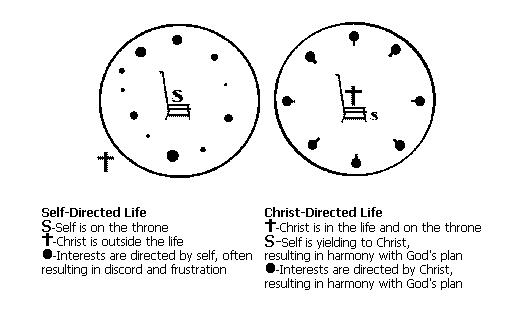
Which circle best represents your life?
Which circle would you like to have represent your life?
http://www.campuscrusade.com/fourlawseng.htm
True conversion, according to this tract, is not a mere intellectual assent or a mere emotional experience. But gosh, what is it then??? If it is not what I think or what I feel then how do I know I am really “born again”? How do I know that I had not deceived myself into a false conversion? The tract then goes on to say that truly receiving Christ involves turn for God to self. It means converting from a self-directed life to a Christ-directed. I recall seeing those two circles.
After years as an evangelical, I would look at these two circles and answer the question “Which circle best represents your life?” by choosing “None of the above”. Even now, I am not the circle on the left, but neither am I the circle on my right. The circle on the right is a saint. I am not a saint. But I do see progress. More and more I am being changed into His likeness. But I am not there yet. So if absolute assurance means that I must have Christ totally on the throne of my life, then how can anyone be absolutely assured of his salvation?
Conversion is not a one-time experience. It is periodically turning more to God in the confessional and receiving Christ in the Eucharist, it is not a one-time commitment. Getting to that circle on the right is a life-time process. And since it is a lifetime process we can never get to the point we are absolutely sure of our salvation. We serve a merciful God. We should never despair. God knows we are but dust, so although we cannot be absolutely sure of our salvation, we can still be reasonably sure if we are seeking to please Him. But we must humbly examine ourselves in prayer to make sure that we do sincerely seek to please Him. We need to look at ourselves daily and honestly look at ourselves as to why we are not yet the circle on the right. We must not presume that we are there already.
Our Knowledge of God
God says throughout the Bible that His ways are not our ways. This is the whole point in God forbidding the making and worshipping of graven images. It is not that He was against graven images per se. He also commanded Moses to built graven statues of angel on both sides of the covenant. But at that time, people made images of their gods because they thought the images themselves were the gods. By making these images, the people would control their gods. God wanted them to understand that He was not to be controlled. Again, it is Kant’s idea of reality versus of our perception of reality. God in reality is much greater than our perceptions of Him. Augustine once said that if you think you understand what God is like then it is not God.
Many Protestants accusing us of breaking God’s commands against graven images by us having status. But no Catholic believes that the statue is actually God. These statues help in our devotion toward God, but realize that God is bigger than those statues. Many Christians, both Protestant and Catholic, have a mental image of God looking like a wise old man with a white beard. And they picture His Son to look like Jeffrey Hunter or Jim Caviesel. In fact, it would be very difficult to maintain a mental non-image of God. So we all have a mental picture of what God is like. That is fine, as long as we remember that God is far more that. Our perception of God could never capture what God is like. The finite could never comprehend the infinite.
But because of our sinfulness, we constantly try to reduce God into our image of Him. We box God into our nice categories so that we tamed Him. We have this image of a loving Father, and then throw anything in the Bible that shows He is also our Judge. God cannot be reduced to one word, except for what He said to Moses when Moses asked Him His name. God said “I am who I am”. Nothing else captures who God is as this.
Most of the heresies throughout history is the result of the failure to realize that we can never fully comprehend God. The Unitarians reject the Trinity because they could not comprehend the one being three persons. The Gnostics rejected the humanity of Christ because it contradicted their perception of the deity of Christ. The Arians rejected the deity of Christ because it contradicted their perception of the humanity of God. Luther rejected man’s need for works for salvation because it contradicted his perception of grace of God. Calvinists reject man’s free will because it contradicts their perception of the sovereignty of God. Atheists today reject God entirely because of the suffering in the world contradicts their perception of a loving God. Heresies reject one truth because it contradicts another truth.
This is why God commanded the Israelites not to make graven images of Him. It was not because God is against making art to the glory of God. It is because God demanded us to let God be God. God is greater than our own puny ideas of God. But this does not mean that we cannot entertain thoughts of God. We must still do theology. And we can have images of what God is like – both physical and mental images. And we can and must have conceptual images of God. But we must remember that in all our images of God, we must remember that God is greater than them. Our perception of Him can never capture His essence. We must accept everything He has revealed to us, even if we do not yet understand it yet. Right now we see though a mirror dimly, but then face to face.
The Eucharist
Aristotle taught that there is a difference between form, also called accidents, and essence, or substance. For instance, my essence is that I am Paul Ackermann. My form has changed throughout the years. I look entirely different now than I was when I was a baby. I have gone through many changes, but essentially I am still me. So me essence remains the same, although my physical form changes.
Thomas Aquinas applied this teaching from the Aristotle to the Eucharist. This is the only time that the form remains the same but its essence changes. At consecration the substances of bread and wine change to the actual body and blood of Christ. The form remains the same, but its substance changes.
Again, our perception is different than reality. Our perception is that it remains the same. The consecrated host still looks, tastes, and feels like bread. But its substance has changed. It is the body of Christ. How do we know that, since it still looks, tastes, and feels like bread? Because Jesus said so! He said “This is my body”. Jesus said it; I believe it; that settles it! So in spite the phenomenal world still indicating that it just bread, I walk by faith and not by sight.
Conclusion
Christianity, especially Catholicism, is the only system of thought that embraces both objective reality and subjective experience of that reality.
Atheism goes to the extreme of materialism. Atheists brag that they only believe in empirical, verifiable, scientific truth. Since God cannot be verified scientifically, so they say that God should not be believed. But this is self-contradictory. The rule that everything must be scientifically verified or else should not believed cannot itself be verified scientifically. But Kant and Schopenhauer showed this rule is a fallacy because no one can achieve totally objectivity. Even our scientists bring their subjective experiences and biases into their conclusions. This is important to keep in mind, when a Christian, especially in college, is confronted with “evidence” from allegedly “objective experts” that is supposed to totally refute the Christian faith. No one is totally objective, so we must take what these experts say with a grain of salt. Power corrupts and absolute power corrupts absolute. In the medieval times, power resided in the Church. In totalitarian governments power reside in the state. Today, power resides in the scientific elites. We must be careful not to give blind faith and obedience to them.
Things are not the way they appear. Reality must be filtered through our sense before we can decipher that reality. We each bring our past subjective experiences and biases that influence the way we view things. The Catholic Church has always affirmed this. It says that the way we interpret the Bible and what it actually says are two different things. This is why we have over 25,000 different denominations, most of them saying that they are basing their teachings on the Bible. Luther said that the Bible is plain enough that even a school boy can understand it. History, with the different interpretations of the Bible, has proven him wrong. This is why God has given us a living interpreter, the magisterium, so that we can know how to interpret the Bible for us today. Protestantism is based on having absolute knowledge – each one of us can know absolutely what the Bible teaches for them, each one us of can be absolutely assured that he can go to heaven, and each one of us know who goes to hell (anyone who is not a Christian).
The Catholic Church rejects this individualistic dogmatism. Even the pope is far less dogmatic than the typical Fundamentalist preacher. Not everything that the pope says is infallible – only what is said ex cathedra, and the pope does not have the freedom to reverse any official teachings declared by a past pope or council. So that severely limits what the pope can declare after two thousand years. Almost everything has already been declared.
The Catholic Church also rejects the idea that we know who is going to heaven and who is going to hell. The Church can declare what is objectively a mortal sin, but the Church does not declare who is subjectively responsible for that sin.
But this individualistic dogmatism in Protestantism opened the doors to the rationalism of the Enlightenment. The Enlightenment thinkers took what Luther said one step further. Luther said that that an individual can know the truth from the Bible without the aide of the Church. The rationalists then said that we can know the truth without the aide of the Bible. The all the different viewpoints convinced many that there was no absolute, objective truth at all. Without the Church, we go from one extreme to another. First we thought we can find the truth without the Church. Then we thought we could find the truth without the Bible. Then we thought we could find the truth without God. Now we declare that there is no truth.
